A Barrel of Laughs, A Vale of Tears
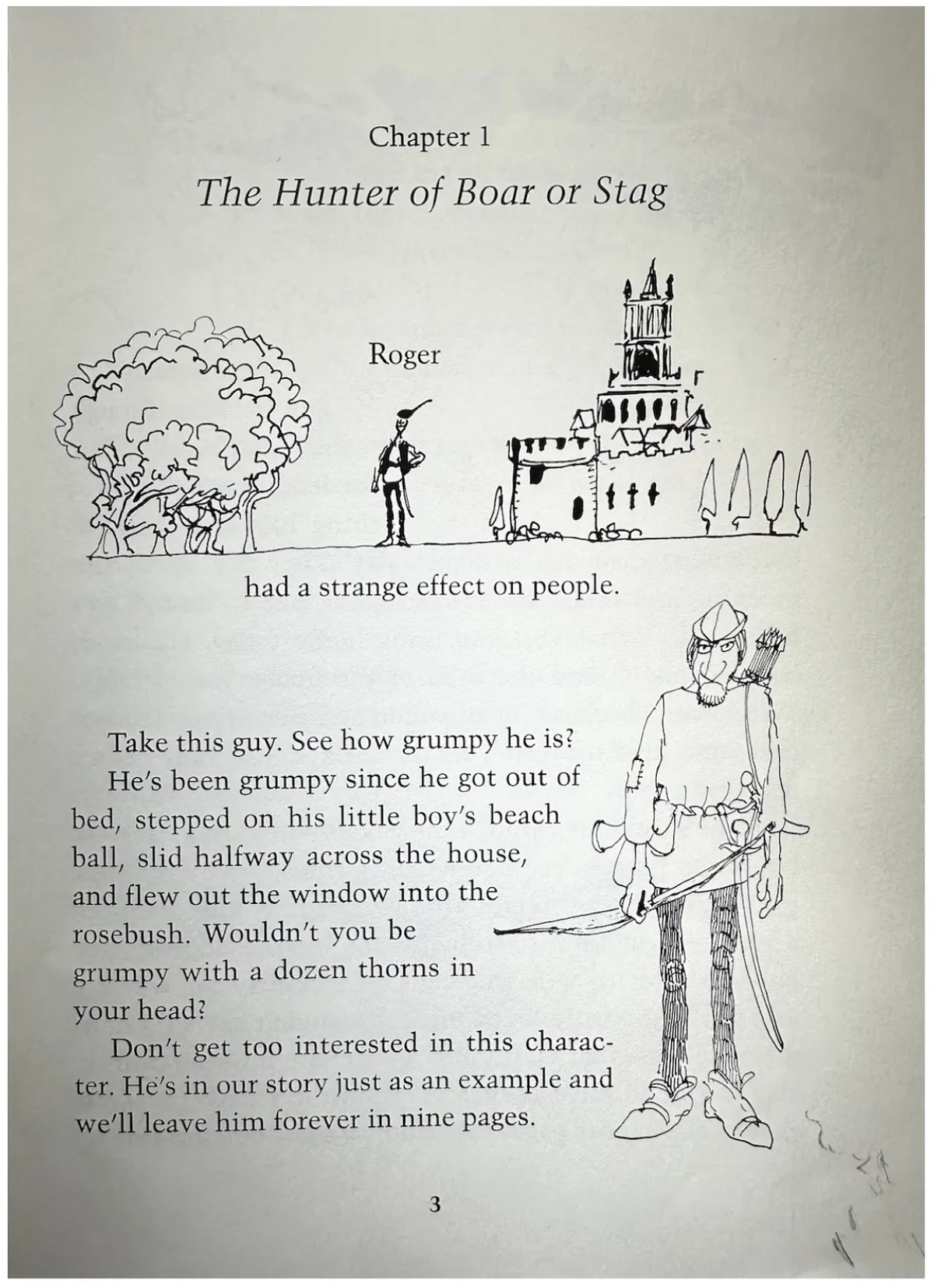
This is the first page of a Barrel of Laughs, A Vale of Tears. Complete with some vintage late 90s scribbles. It’s probably a stretch to say that this page is the reason I write now, or even the reason that I write the way that I do, but it is accurate that it blew my tiny, six year old mind.
I’m wary of a habit for conflating your own first experience of something with the first example in history (I was that annoying kid in film school taking pains to correct every time someone said Quentin Tarantino when they meant to say postmodernism (More out of my own juvenile aesthetic revulsion to Tarantino’s work than for actually knowing what I was talking about)). But still, this has everything. I think the page does stand for itself where description alone wouldn't. The single line ‘Roger’ followed by illustration where roger (Our protagonist) is barely perceptible among a castle and trees, almost a quarter of the page taken by a character we’re promised won’t last the next nine pages. I don’t want to overly credit my six year old self, but the invitation provided by the line “He’s in our story as an example and we’ll leave him forever in nine pages.” tells us that there are no rules in this book, that, even if it were true that we were going to leave the character in nine pages, the way it’s done will be similarly surprising and delightful.
You won’t be particularly surprised that in nine pages time our character, the hunter of boar of stag, stays on an extra page. He’s overcome with laughter: the strange effect Roger has on people. Having broken this initial promise, the hunter will continue to come back throughout the book as antagonist.
There is a tendency when reading children’s books as an adult to mine them for life lessons. The pedagogy in A Barrel of Laughs is at times obvious, and at times subtle. Roger begins his journey causing laughter and delight through his mere presence. With a brother and sister who came along relatively late and I’d had four years as an only child before my parents attention was divided. The transition between inspiring delight just for existing, through to having to create it yourself, is a tricky one. Full of false starts: The rote structure of jokes and games. For years I thought hilarious in a sarcastic, exhausted intonation was my mother’s generic term of acknowledgement in the way you’d (or once would) use lol. But in some of the ways the book is more literal, it’s even more delightful. Roger is sent on a Quest by J.Wellington Wizard not to any specific aims, but because he feels the act of questing will have a positive effect on his character. During this quest Roger is attached by stones which barely hurt, but which contain hurtful messages, and we’re treated to:
”He was amazed at how often Roger, the prince’s name, came up in the course of the flights. “Roger is not going to believe this.” “We must remember every detail to tell Roger if we’re lucky enough to meet him again.” “I bet Roger would make the noble eagle laugh so hard he’d drop him.” After hearing such remarks, did it occur to Roger that his friends didn’t hate him, that the rocks had lied? Not at all. He had been through too much; he found it easier to accept a vile lie wrapped around a rock than a sweet truth spoken by a friend.”
Throughout his quest, Roger meets a range of The Little Prince style characters. Some are conceited or one note. Most are more character than archetype, and show themselves capable of change, humour, empathy. Whereas The Little Prince is beautiful in its imagery and poetry, Barrel is I suppose more terrestrial, and cheeky. It’s Frank Ohara after a diet of Ted Hughes.
And then the ending, which rocked my tiny brain. In high school a teacher told me he took his daughter and her friend to see Shrek when it first came out, and the friend was mortified to see the princess not only become, but remain an ogre. I can’t help but feel like A Barrel of Laughs inoculated me against the idea of a clean and beautiful pairing. Though it’s possible that I was already an odd child, or that boys just receive a less particular model of self. Roger eschews the Princess he has rescued (and, more frequently, been rescued by) for Lady Sadie, the practical and plain-spoken heroine with whom he has shared experience, witnessed change, and now delights in making smile. Princess Petulia likewise chooses Phillip the giant who has melted her stony resolve. Toward the end of the book Lady Sadie tells Roger:
“sometimes you’re so funny I want to hug and kiss you—and some- times you're so sweet I want to hug and kiss you—and sometimes you're so sad I want to hug and kiss you— and sometimes you’re so maddening I want to kick you.”